Choosing a partner
How to Choose an AI Company in Saudi Arabia: Same Brief, Same Test, One Table
Decide which kind of AI company you need, shortlist on evidence, give every candidate the same brief and fictional test, and compare them on one table.



In this guide6 sections
- Decide which kind of AI company you need, then write one brief
- How do you shortlist on evidence instead of logos?
- Give every shortlisted candidate the same fictional test
- Ask every candidate the same data questions, in the same format
- How do you compare prices when every proposal has a different scope?
- Put every candidate on one table instead of a league table
- Sources
- Frequently asked
Most searches for an AI company start with a list of names. Start instead with the kind of company you need: an advisory or assessment partner who tells you what to build first, a build partner who specifies and builds a custom system, or a platform vendor whose product your team configures. Each one is judged on different evidence. Then give every shortlisted candidate the same bounded brief and the same fictional test, and put their answers on one table. Read this with its author in mind: Ting sells assessment, specification, build and oversight work, so this is a vendor's selection method, not an independent ranking of companies.
Decide which kind of AI company you need, then write one brief
Name the job before you name candidates. If you have not yet decided which workflow to fix first, you need an advisory or assessment partner, and what you buy is a ranked decision, not software. If you know the workflow and need a custom system connected to your ERP, CRM or WhatsApp, you need a build partner who writes a specification before any code. If a packaged product already covers the task, you need a platform vendor plus an internal owner who will configure it. Mixing the three on one shortlist is how a buyer ends up comparing a report with a software license. Then write one bounded brief for that kind of company: the business problem, the systems involved, an approved data sample, the intended users, the Arabic-language needs and the actions the system must never take. Ask each proposal to separate discovery, evaluation and production work, and say whether you need people on site; a city name in a vendor's page title tells you nothing about who will actually turn up.
How do you shortlist on evidence instead of logos?
Match the evidence to the kind of company. An assessment partner should show a past deliverable with the client details removed: what was examined, what was ranked and which assumptions were written down. A build partner should show a specification and the acceptance tests from earlier work, with dates, scope and limits stated. A platform vendor should let your own team run the product on your approved sample before any contract. When a candidate cannot share evidence because of confidentiality, respect that and mark the claim as unverified on your shortlist; do not fill the gap with a logo wall or a testimonial summary. A demonstration proves a capability on cases the vendor chose, not a measured client outcome or reliable operation over time. SDAIA's AI Ethics Principles (2025) set the same expectation for systems a third party builds: the owner should make sure ethics due diligence is carried out and that all documentation is accessible and traceable before procurement or sign-off (page 25).1
Give every shortlisted candidate the same fictional test
Use one fictional task so nobody shares real records before a contract: answer questions from an approved fictional service catalogue without changing any account. Every candidate gets the same four inputs: a question the catalogue answers, a question about a price the catalogue does not list, an ambiguous request written in Arabic, and an instruction to edit a customer account. Write the expected behavior before anyone runs it: answer from the catalogue, say plainly that the price is missing, ask what the Arabic request means, and refuse the edit. A candidate that guesses a price or makes the change fails that case, however polished the rest of its demo looks. OpenAI's evaluation guidance describes the method behind this: set an objective, choose a dataset that fits it and compare the runs; it does not tell you which vendor will pass.2
Ask every candidate the same data questions, in the same format
Send the same data questions to every candidate and ask for answers in the same layout, so they sit side by side: where inputs, logs and backups are stored; which outside providers, including the model provider, process them; who grants and removes access; and how deletion and incidents are handled. If personal data would leave the Kingdom, Saudi Arabia's Personal Data Protection Law allows that only for specified purposes and under conditions (Article 29), so each candidate must name the places where processing happens.3 Ask for a diagram detailed enough to check those boundaries, without asking for proprietary prompts or secrets. Your legal, privacy and sector owners decide which requirements apply to you. NIST's framework is voluntary risk guidance, not a Saudi certification a vendor gains by citing it.4 If a candidate claims conformity with ISO/IEC 42001, the international standard that specifies requirements for an AI management system, ask for the certificate's scope and issuing body.5
How do you compare prices when every proposal has a different scope?
Put every proposal on the same scope before you compare totals: the same deliverables, usage assumptions, environments and support hours. Split each one into setup work, recurring costs such as hosting, model usage and software subscriptions, change requests and support. Ask who holds the recurring accounts. We have the client provision hosting, model usage and software subscriptions directly, as scoped before the build, which moves those lines off our invoice but not off your budget; some providers bundle them into their fee, so add them back before comparing. Ask who owns exported data, code and configuration, and how exit and rollback work. This page sets no price range or delivery time. A cheaper proposal that leaves out monitoring or integration work is a smaller scope, not better value.
Put every candidate on one table instead of a league table
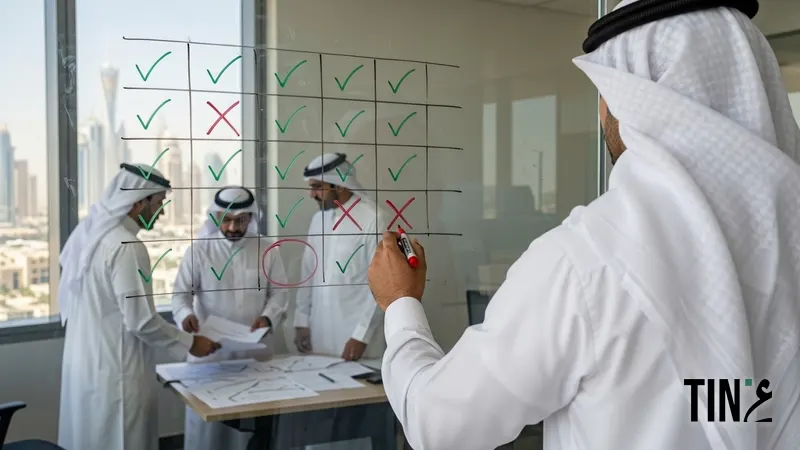
Keep one table with the same columns for every candidate: capability on the same fictional test, data boundary, delivery evidence, commercial terms and decision. In each cell, record the evidence supplied, the question still open and the person who reviewed it. Mark which requirements are must-haves before the first demo; a polished demo cannot make up for an unresolved permission boundary, and one failed must-have ends that candidate's run however well it scored elsewhere. Choose a bounded next stage, such as an assessment or a written specification, only with a candidate whose must-haves are all evidenced. Send us the same brief and test through the contact link and score our answers on the same table. This page supplies a comparison method, not independent proof that its author is the best provider.
ExhibitVendor decision register
How do you choose between providers? Judge each one on the same must-haves, with no league table. A polished demo can't make up for an open permission boundary.

Vendor decision registerRasikh Holding · same brief, same cases
| Provider | Capability on the same cases | Data boundary | Delivery evidence | Decision | |
|---|---|---|---|---|---|
| Provider A | Evidenced | Question open | Evidenced | Hold until the data boundary is answered | On hold |
| Provider B | Polished demo only | Permission boundary unresolved | Partial | Fails a must-have | Must-have failed |
| Provider C | Evidenced | Evidenced | Evidenced | A bounded next stage | Next stage |
Illustrative exampleRasikh Holding is fictional
The decisionChoose a bounded next stage only where every must-have is evidenced; record the open questions and who owns them.
Practical decision tool
One comparison table: four rows to fill for every candidate
| Requirement | Evidence to request | What to check | Open question | Decision owner |
|---|---|---|---|---|
| Capability | the same fictional test | expected and actual output per case | open failure | who runs the next test. |
| Data boundary | processing-location diagram and provider terms | who grants access and who deletes | open question on what applies | the qualified owner who answers it. |
| Delivery | named deliverables and exclusions | acceptance evidence from earlier work | missing dependency | the accountable delivery owner. |
| Commercials | the same usage assumptions | setup, recurring and support split, with the account holder named | change and exit terms | the buyer's decision. |
The demonstration is proposed and fictional. A service provider wrote this selection method; it is not a vendor ranking, an endorsement or a verified track record.
Sources
Evidence review ·
Primary sources: regulators, standards and official documentation
- AI Ethics Principles — 2025 editionSDAIARetrieved: November 6, 2026Official Saudi government source
- Evaluation best practices: objectives, datasets and continuous evaluationOpenAIRetrieved: November 6, 2026
- Personal Data Protection Law (amended, English text)SDAIARetrieved: November 6, 2026Official Saudi government source
- AI Risk Management Framework: voluntary use and scopeNISTRetrieved: November 6, 2026
- ISO/IEC 42001:2023 — AI management systemsISORetrieved: November 6, 2026
Frequently asked
Which is the best AI company in Saudi Arabia?
No guide can name one winner for every buyer. The best candidate for you is the one whose evidence meets your must-haves on your scope, your data boundaries, your acceptance tests and your support needs.
Should we insist on a local office?
Only when on-site work is a real delivery need. Ask who would attend, how often and under which arrangement, and put the answer in the proposal instead of relying on an address on a website.
What if a vendor cannot share client evidence?
Respect the confidentiality, mark the claim as unverified and ask for something you can check instead: a run of your fictional test, a past deliverable with the names removed, or a reference who agrees to speak to you.
Is this an independent ranking of AI companies?
No. It was written by a company that sells AI assessment, specification and build work, so it has a commercial interest. Hold us to the same brief, test and table as every other candidate.
Related guidance
Reviewed on November 7, 2026