Cost & finance
How Much Does AI Cost a Company in Saudi Arabia? The Cost Lines You Will Pay
The cost lines behind an AI system, what drives each one, and why a fixed quote comes only after the solution is specified. Not a price list.


In this guide6 sections
What AI costs a company depends on what the system has to do inside your operation, so no honest answer starts with a number. It starts with the cost lines: build and setup, integration with your systems, model usage, hosting and software subscriptions, support, and change requests. This page explains what drives each line and why a fixed implementation quote exists only once the solution is specified. It also gives you a browser-local worksheet to compare one-time and recurring costs with the value of the time you expect to free. The worksheet's starting numbers are fictional, freed time is not cash saved, and nothing you type is submitted or saved.

AI budget worksheetWorksheet version
Interactive planning worksheet
Work out a first-year AI budget
Start from a fictional scenario, then replace the inputs with your own quotes and measured workflow data. These are not Ting prices, market benchmarks or promised results.
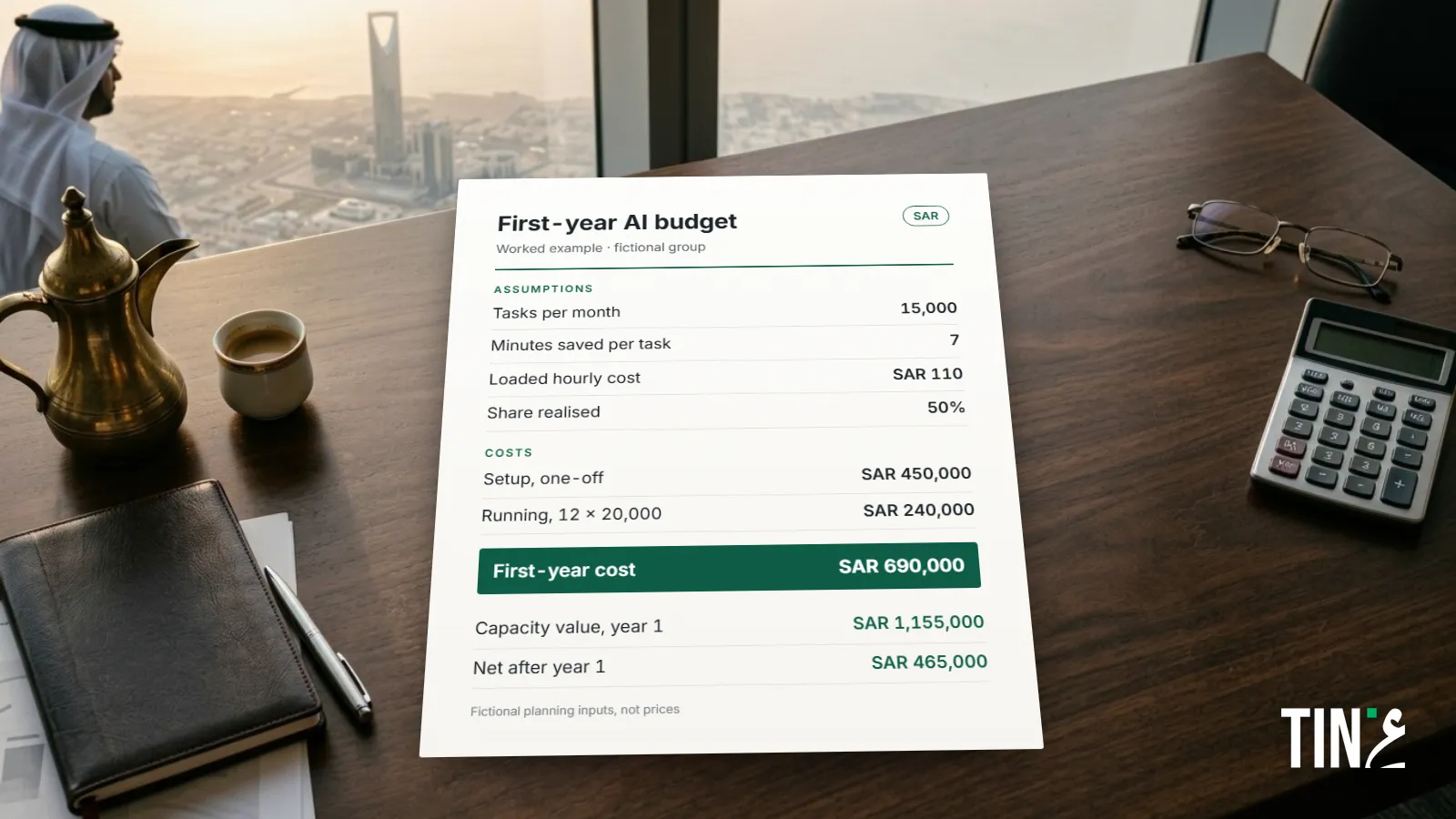
Fictional scenario · not a client result Rasikh Holding, a fictional group: five companies, about 15,000 requests a month, a custom build across their systems.
- Value of time freed, per year
- 1,155,000 SAR
- First-year total cost
- 690,000 SAR
- First-year net value
- 465,000 SAR
- Payback (estimate)
- 5.9 months
How the worksheet works
Value of time freed per year = tasks a month × minutes saved ÷ 60 × hourly staff cost × useful-work share ÷ 100 × 12. First-year cost = one-time budget + monthly operating budget × 12. First-year net value = value of time freed − first-year cost. Payback = one-time budget ÷ (monthly value of time freed − monthly operating cost), only when that difference is positive.
Include discovery, integration, testing and training in the one-time budget. Include model usage, infrastructure, maintenance and human review in operating costs. The calculation excludes taxes, financing, discounting and unbudgeted risks.
Time freed is not cash saved. Saved staff time becomes a financial benefit only if you can productively redeploy it or actually reduce a cost. Validate time savings and adoption in a pilot before using the result in a business case.
Calculations run in your browser. This worksheet has no submit or save function.
Which cost lines will your company actually pay?
An AI system that works inside your operation is paid for in several lines, and a quote that shows only one of them is incomplete. Build or setup covers the specification, configuration, custom components, testing, training and handover. Integration work covers each connection to your ERP, CRM, email or WhatsApp. Model usage, hosting and software subscriptions recur every month; when we build, the client provisions these accounts directly, as scoped in the AI Solution Blueprint, so they appear on your own cloud and model bills. API model usage is metered by volume: OpenAI's API pricing page, for example, lists separate input and output prices per million tokens for each model, so estimate it from token volumes measured in a pilot.1 Support and change requests are the last two lines; check that a quote prices them instead of leaving them for later. A ready-made product and a custom integration are different scopes, so do not compare their prices without writing down the difference. This guide makes no claim about Saudi salaries, talent shortages or a typical project cost.
What drives the size of each cost line?
Each line has its own driver, so measure the drivers before you ask for quotes. Build cost grows with the number of behaviors and exceptions the system must handle, not with the number of screens. Integration cost grows with every system the AI touches and with whether it only reads data or also writes it back. Model usage grows with request volume and the length of each request and answer; hosting grows with the number of environments you keep and where the data must stay. Support grows with the hours and languages you need covered, and change requests with how much the scope moves after sign-off. Testing is part of the cost too: OpenAI's evaluation guide recommends matching objectives and datasets and evaluating changes continuously, and every re-run after a change is paid work.2 On the value side, count comparable monthly tasks and measure staff touch time before predicting any minutes saved, keep unresolved and failed tasks in the count, and treat the useful-work share as an assumption, not a benchmark.
Check the fictional starting calculation
The starting example assumes 1,000 tasks per month, 6 minutes saved per task, an hourly staff cost of SAR 100 and a useful-work share of 50%. That gives 50 productive hours per month and SAR 60,000 a year in value of time freed. A fictional one-time budget of SAR 40,000 plus SAR 1,500 a month in operating cost gives SAR 58,000 first-year cost and SAR 2,000 first-year net value. Modelled payback is about 11.4 months, not a promised financial return. These are illustrative inputs, not a vendor price or a market rate; replace each one with your own quotes and measurements.
What happens to the budget when the assumptions are wrong?
Lower the useful-work share or the minutes saved and raise the operating cost to see how fast the result turns. If the monthly value of time freed does not exceed the monthly operating cost, the worksheet reports no modelled payback. A zero or negative net value is a valid planning result, because it shows which line has to move before the project makes sense. The worksheet's downside tab does this for the fictional Rasikh Holding group: fewer minutes saved, less of the time put to use and higher running costs. Keep optimistic, expected and adverse scenarios side by side with the reason for each assumption, and do not tune the inputs until a purchase looks justified.
What does the worksheet leave out?
The worksheet leaves out taxes, financing, discounting and risks nobody has budgeted for, so it is not a full cash-flow valuation. Where Saudi VAT applies at the standard rate, ZATCA's guidance sets it at 15%; confirm the treatment of each quote with your tax owner.3 Do not subtract a grant or incentive until an actual award and its terms are confirmed. Hosting location changes cost as well, so agree with your privacy and sector owners where the data may be processed before you compare hosting quotes; no universal hosting rule is set here. NIST's cited framework is voluntary risk guidance, not a funding or compliance source.4
When can anyone give you a fixed implementation quote?
A fixed implementation quote can exist only once the solution is specified: what the system does with exceptions, which systems it reads from and writes to, who may approve what, and which acceptance tests it must pass. Before that point, any figure is a range resting on assumptions. That is why our AI Solution Blueprint ends in a defined implementation quote; you can build with us or take the specification to another team. Whichever route you take, keep the scope, the dated quotes, the baseline measurements and the scenario assumptions with the decision record, and name who checks usage charges and who carries overruns or failed work. After go-live, replace assumptions only with measured values of comparable scope, and track actual spend, time freed and cash savings separately.
Practical decision tool
Four budget checks before you commit
- Scope: each quote names its deliverables, integrations, exclusions and who runs the system after handover.
- Inputs: task volume, minutes saved and the useful-work share each carry an evidence reference or a visible assumption label.
- Sensitivity: keep an adverse scenario, including no payback when running costs consume the value of time freed.
- Decision: keep first-year cost, modelled value of time freed and actual cash impact apart; unconfirmed grants stay excluded.
The worksheet values are fictional assumptions, not Ting prices, Saudi market averages, grants, client results or financial advice.
Sources
Evidence review ·
Primary sources: regulators, standards and official documentation
- API pricing: prices per 1M tokensOpenAIRetrieved: November 6, 2026
- Evaluation best practices: objectives, datasets and continuous evaluationOpenAIRetrieved: November 6, 2026
- Guideline on Professional Services under VAT ProvisionsZakat, Tax and Customs Authority (ZATCA)Retrieved: November 6, 2026Official Saudi government source
- AI Risk Management Framework: voluntary use and scopeNISTRetrieved: November 6, 2026
Frequently asked
How much does an AI project cost a company in Saudi Arabia?
This page sets no market price. The cost follows the scope: how many systems the AI touches, what it may do on its own, how much it is used and what support you need. Define that scope, then compare actual quotes line by line.
Is the value of freed time the same as cash savings?
No. Freed time becomes a financial benefit only when you move it to productive work or actually stop paying a cost.
Why does the worksheet show no payback?
There is no modelled payback when the monthly value of time freed does not exceed the monthly operating cost. Do not hide that result by changing assumptions without evidence.
Can we deduct expected government funding?
Not until an actual award and its conditions are confirmed. This guide identifies no open programme or eligibility decision.
Related guidance
Reviewed on November 7, 2026