Cost & finance
Where AI Fits in ZATCA Invoice Automation, and What Must Stay Rule-Based
AI reads incoming supplier invoices and matches them to orders; the e-invoicing solution generates and submits invoices by rules. Where that line sits, with six acceptance cases.


In this guide6 sections
- Which invoice work are you asking AI to automate?
- Where does AI genuinely help with incoming supplier invoices?
- What must stay rule-based inside the e-invoicing solution?
- How should the workflow show what the system actually confirmed?
- Which six cases should pass before the AI can write to your ERP?
- What should finance receive before go-live?
- Sources
- Frequently asked
AI can read a supplier's invoice, match it to the purchase order and the goods receipt, and send the mismatches to a person. It cannot turn a scanned invoice into a ZATCA electronic invoice. ZATCA defines an electronic invoice as a tax invoice generated electronically in a structured format and explicitly excludes paper invoices converted by scanning or copying.1 So a ZATCA invoice automation project has two halves: an AI half on incoming documents, where uncertainty is normal and gets routed to people, and a rule-based half inside the e-invoicing solution, where invoices are generated and submitted from structured data. This guide shows where that line sits and gives six proposed acceptance cases. It is not a tax opinion, a complete technical specification or a compliance certificate.
Which invoice work are you asking AI to automate?
Name the task before you name the tool. Reading incoming supplier invoices for accounts payable, matching them against purchase orders and goods receipts, generating outgoing invoices to customers, and connecting an e-invoicing solution to ZATCA are four different jobs with different owners. For each one, write down the input, the owner, the expected output and the system actions it may take. A proposal described only as ZATCA-ready AI, without that boundary, is not something finance can approve.
ZATCA's definition page distinguishes a generation phase from an integration phase and says the integration phase is implemented in waves.1 Its roll-out page adds that ZATCA notifies taxpayers of their Phase 2 wave at least six months in advance.2 Do not infer an organization's wave or obligations from this article, and in a group with several companies, confirm it entity by entity rather than once for the group. The tax owner and the e-invoicing system owner should confirm applicability, invoice types and the current official requirements before anyone configures the workflow.
Where does AI genuinely help with incoming supplier invoices?
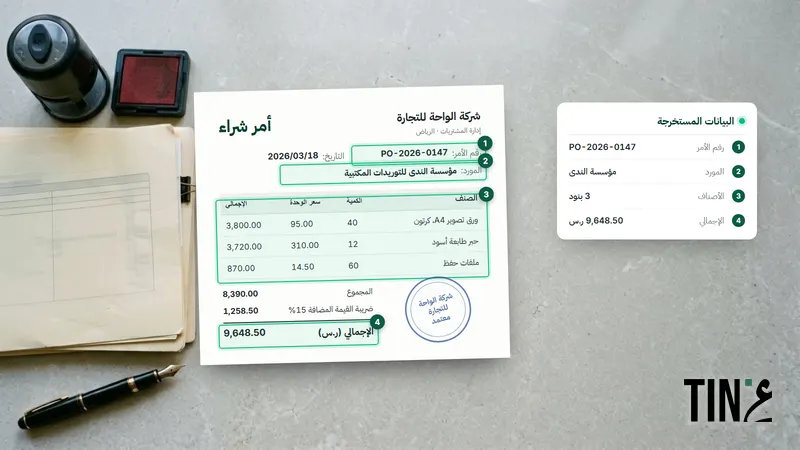
On the accounts-payable side, supplier invoices arrive as PDFs, scans and photos, in Arabic, English or both, in layouts you do not control. That is where a model earns its place: it reads the document and proposes fields such as supplier name, VAT number, invoice number, date, line items and totals. Store each proposed field as a candidate with its location on the source page and any uncertainty, and keep a reference to the original document. Never replace an unreadable value with a plausible number. If a supplier already sends structured invoice data, use that before adding a reading step.
The second job is matching the invoice to the purchase order and the goods receipt in your ERP. AI helps where the match is fuzzy, such as a supplier name written in Arabic on the invoice and in English in the vendor master, or line descriptions that differ from the item catalogue; the tolerance rules themselves stay explicit. A short receipt or a price that differs from the order goes to a named person with the reason attached, not to a shared inbox. Test this on an independently checked reference set with poor scans, ambiguous numbers and unfamiliar layouts. A model's confidence score is not proof that a field is correct, and this guide reports no measured extraction accuracy.
What must stay rule-based inside the e-invoicing solution?
Outgoing e-invoices are a different job. The e-invoicing solution generates each invoice from approved structured data, produces the XML and handles clearance or reporting where the integration phase applies, and none of that should depend on a model's judgement. ZATCA's specifications page links an Electronic Invoice Data Dictionary and an XML Implementation Standard, both labelled 19 May 2023 on the page reviewed.3 The page describes the dictionary as defining data elements and the XML standard as specifying syntax and business content. The date we retrieved the page is not a new edition date for those documents.
Ask whoever implements it for a versioned field-and-rule mapping: required input, official reference, validation rule, failure message and responsible system. AI can still help upstream, for example by flagging an unusual order before an invoice is raised, but it should not decide a tax amount, an invoice type or any field value the specification fixes. A visible QR code or a correctly added total does not establish that the complete invoice satisfies the applicable requirements. ZATCA's SDK page also states that meeting the requirements of its SDK verification does not imply that the e-invoices have been approved by ZATCA.4
How should the workflow show what the system actually confirmed?
Give the incoming workflow its own states and keep them honest: received, candidate extracted, checks failed, ready for the authorized operation, outcome unknown and outcome confirmed. These are our proposed workflow labels, not ZATCA API status names. A record that fails a check is held with the exact rule that stopped it. Record the destination system's actual response and the operation it confirms, instead of reading every successful HTTP response as an accepted invoice.
If a connection times out after a request is sent, the outcome is unknown: neither failed nor successful. Use the destination system's supported status and duplicate-handling mechanisms before any retry; do not invent an idempotency parameter or repeat the operation blindly. Ask the supplier to show the real recovery path in an authorized test environment, including who owns an unresolved exception. ZATCA's Developer Portal manual describes its Integration Sandbox as meant for testing purposes only; inputs submitted there are not considered acknowledged, approved or accepted by ZATCA.5
ExhibitDocument workflow states
When can an extracted record move on? Only on its checks: extraction produces a candidate, and a timeout stays unknown until the destination system confirms.
Incoming document statesTing workflow labels · not ZATCA status names
- ReceivedThe source document is kept
received - Candidate extractedFields stay separate from the record
candidate_extracted
If a check fails
- Checks failedHeld, with the exact rule
checks_failed
If every check passes
- Ready for the authorized operationOnly after every check passes
ready - Outcome unknownA timeout: check before any retry
outcome_unknown - Outcome confirmedThe destination's own response
outcome_confirmed
One test line
Quantity 2 × unit amount 100= 200Document says 250Flagged: arithmetic mismatch
Illustrative exampleFictional figures
The decisionAccurate reading is not acceptance: a record moves on only on its checks, and only the destination system confirms an outcome.
Which six cases should pass before the AI can write to your ERP?
The six cases below are an acceptance-test design, not an executed benchmark or a complete ZATCA test suite. Run them with authorized test data and the rules you actually agreed. For each one, capture the input, expected behavior, actual result, rule version, system response and the reason it passed or failed. Keep production writes switched off while you test an extraction-only pilot: the AI proposes, and a rule or a person approves.
Report field errors, wrongly accepted records, duplicate business operations and unresolved outcomes separately, because each one costs finance something different. Put the denominator and the mix of tested documents next to any rate. Compare against a measured baseline before claiming time saved. Passing a small test pack does not prove legal compliance, fraud detection or reliable handling of every supplier's format.
What should finance receive before go-live?
Before rollout, ask for the agreed scope, field mapping, rules version, evidence that the tests ran, error handling, access controls, retention decisions and named support owners, plus a change procedure for when invoice rules, supplier layouts or destination interfaces change. These are proposed delivery requirements, not a claim that every vendor already supplies them. In Custom AI Implementation, our service for AI invoice automation like this, five things are settled in writing before the build: what data the system reads, where it is processed and stored, who can access it, what is logged and how long it is kept.
Build the estimate from your own document volumes, exception rates, provider terms, integration work and support needs; no universal implementation duration or savings percentage is established here. If one entity's supplier invoices form the busiest queue, start there and extend to the others once the six cases pass. The linked Arabic document example is educational and does not validate a ZATCA invoice.
Practical decision tool
Six acceptance cases before AI writes to your ERP
- Unreadable identifier — input: a scan with an unclear identifier required by the agreed workflow. Expected: retain the source, flag the field and block acceptance; do not invent a value.
- Arithmetic mismatch — input: a fictional line with quantity 2, unit amount 100 and line subtotal 250. The test rule is multiplication only. Expected: flag 250 versus 200; this is not a VAT calculation or valid tax-invoice example.
- Repeated input — input: the same approved test record delivered twice. Expected: demonstrate the agreed duplicate policy without creating a second business operation merely because extraction ran twice.
- Rule failure — input: a record deliberately violating one documented rule in the authorized test configuration. Expected: record the exact rule and failure; do not mark the invoice accepted because its text was extracted.
- Uncertain response — input: a simulated connection timeout after sending a test request. Expected: keep outcome unknown, inspect supported status evidence and avoid an unsupported success claim or blind retry.
- Unauthorized write — input: an extracted record requesting a system change outside the pilot's permission. Expected: no write, a recorded rejection and the agreed exception route.
All cases are proposed tests, not observed outcomes or a complete official test suite. · The arithmetic fixture is fictional and contains no tax rule or compliance finding. · Real tests require authorized data, the actual applicable rules and a safe test environment.
Sources
Evidence review ·
Primary sources: regulators, standards and official documentation
- E-Invoicing DefinitionZakat, Tax and Customs Authority (ZATCA)Retrieved: November 6, 2026Official Saudi government source
- E-Invoicing roll-out phasesZakat, Tax and Customs Authority (ZATCA)Retrieved: November 6, 2026Official Saudi government source
- E-Invoice specificationsZakat, Tax and Customs Authority (ZATCA)Retrieved: November 6, 2026Official Saudi government source
- Compliance and Enablement Toolbox: SDKZakat, Tax and Customs Authority (ZATCA)Retrieved: November 6, 2026Official Saudi government source
- Developer Portal User Manual (Integration Sandbox)Zakat, Tax and Customs Authority (ZATCA)Retrieved: November 6, 2026Official Saudi government source
Frequently asked
Is a scanned PDF a ZATCA electronic invoice?
No. ZATCA's definition explicitly excludes paper invoices converted by copying or scanning.1 An electronic invoice is generated electronically in a structured format, and extracting fields from a scan does not change that.
Does accurate invoice reading prove ZATCA compliance?
No. Reading quality, the invoice requirements and completion of the applicable e-invoicing operation are separate checks. A plausible extracted record is a candidate, not an approval; verify it against the agreed rules and the system's own evidence.
Where are the official invoice field and XML rules?
Start with ZATCA's official specifications page and its linked Data Dictionary and XML Implementation Standard.3 Record the version you used, and have the implementation owner map the applicable requirements to each field.
What should happen when a request to the e-invoicing system times out?
The outcome stays unknown until the destination system provides reliable status evidence. Follow that system's supported recovery and duplicate-handling process; do not mark it successful and do not repeat the operation blindly.
Can supplier invoices be processed without a person?
On a bounded automatic path, for supported inputs and explicitly authorized operations. Missing values, failed rules, purchase-order mismatches and uncertain responses go to a named person. Automation should never fill a gap silently or skip an unresolved check.
Does this guide tell us our ZATCA integration wave?
No. Confirm applicability and current requirements from official information with your tax and e-invoicing system owners, entity by entity. This guide is an evaluation aid, not a taxpayer-specific compliance assessment.
Related guidance
Reviewed on November 7, 2026